

Most Treasure Valley HOAs require architectural review before fence installation. Submit your application with material specs, color samples, and a site plan showing setbacks. Butte Fence assists with CC&R interpretation and provides documentation packages for communities like Pinnacle, Paloma Ridge, and Prescott Ridge. The typical approval timeline is 14–35 business days.
A new fence in a Treasure Valley HOA community is rarely just a fence project. It’s a documentation project with a fence at the end. Skip the documentation, and the fence comes down—often at the homeowner’s expense—after a violation notice arrives in the mail.
This guide walks through the architectural review process used across Meridian, Eagle, Boise, and Star, with specific attention to the Design Review Boards and Architectural Control Committees that govern most newer subdivisions. The goal is a clean approval the first time, no rework, and a fence that doesn’t generate a CC&R violation letter six months after installation.
Why HOAs Regulate Fences in the First Place
Fences sit at the intersection of two HOA priorities:
Aesthetic continuity and property value protection. A neighborhood where every fence matches (same height, same material, same color, same setback) reads as cohesive, intentional, and valuable. A neighborhood with mismatched fences reads as chaotic and signals weak governance to prospective buyers.
This is why HOA fence rules tend to be specific in ways that surprise first-time submitters. The rules don’t just cover material and height. They often dictate picket profile, post-cap style, color (by manufacturer code, not just “white”), stain finish, distance from sidewalks, and whether the “good side” of the fence faces the neighbor or the homeowner.
Treasure Valley HOAs typically require Design Review Committee approval before any fence installation begins.
This applies whether the community is a newer master-planned development like Pinnacle in Meridian or an established subdivision in Eagle. The Design Review Committee (sometimes called the Architectural Control Committee or Architectural Review Committee) is the body that reviews submissions and issues approval letters. No approval, no fence, and no recourse if the work is done first and challenged after the fact.

What Treasure Valley HOAs Typically Require for Fence Submissions
Specifics vary by community, but the requirements clustered across most Meridian and Eagle HOAs follow a consistent pattern.
| Submission Element | What’s Typically Required |
| Site Plan | Scaled drawing showing fence location, property lines, easements, setbacks, gates, and existing structures |
| Material Specifications | Manufacturer name, product line, gauge or wall thickness, post type |
| Color Samples | Physical samples or manufacturer color code (e.g., “CertainTeed Bufftech Almond”) |
| Height | Specific dimension; some HOAs require both panel height and post-top height |
| Style | Privacy, semi-privacy, picket, ranch rail, ornamental… must match approved options |
| Gate Details | Width, hardware type, swing direction |
| Picture Frame Detail | For wood fences, whether “good side” faces in or out |
| Setbacks | Distance from sidewalk, easements, common lot boundaries |
| Neighbor Acknowledgment | Some HOAs require signed acknowledgment from adjacent owners |
| Contractor Information | Licensed and insured contractor; some HOAs require pre-approved vendor lists |
Submit fence applications with material specifications, color samples (using manufacturer codes), and a scaled site plan.
The manufacturer color code is one of the most overlooked requirements. “White” is not a specification. There are dozens of whites across vinyl manufacturers, each slightly different. HOAs in Pinnacle, Paloma Ridge, Prescott Ridge, and DeMeyer Estates routinely reject applications that don’t cite a specific manufacturer color name or code, because they cannot verify continuity with neighboring fences without it.
Step-by-Step HOA Fence Approval Process
Step 1: Locate the Current CC&Rs and Design Guidelines
CC&Rs (Covenants, Conditions & Restrictions) are the legal document governing the community. Design Guidelines are the practical rulebook the Design Review Committee applies. Both are typically available on the HOA management company’s portal. For many Treasure Valley communities, that’s a portal operated by Elitharp Property Management, Sentry Management, or FirstService Residential.
Read both documents in full before designing the fence. Pay particular attention to: approved materials list, approved colors list, height limits by location (front yard vs. side vs. rear), corner lot rules, common-lot fence requirements, and the specific application form to use.
Step 2: Get a Detailed Site Plan
The site plan is where most rejections originate. It should be drawn to scale and show: property lines (with dimensions), proposed fence location, all easements (utility, drainage, access), setbacks from sidewalks and streets, gate locations and swing directions, existing structures (house, shed, AC unit, sprinkler control valves), and any common lot boundaries.
Many HOAs accept a marked-up plat map from the original recorded subdivision, available through Ada County Recorder for properties in Meridian, Boise, Eagle, Kuna, and Star. Butte Fence prepares site plans as part of the standard quoting process for clients in HOA communities, eliminating one of the most common submission delays.
Step 3: Pull Manufacturer Specs and Color Samples
Request the spec sheet from the contractor. For vinyl fencing, this includes wall thickness (.135 inch is professional grade; .090 inch is big-box), color code, profile (tongue-and-groove, board-and-batten, picket), and warranty terms. For ornamental iron, this includes powder coat color, picket spacing, and gauge. For cedar, this includes lumber grade, post material (cedar, pressure-treated pine, or steel), and stain or sealant brand and color.
Physical samples carry more weight than spec sheets. Most HOA Design Review Committees prefer to see a 4″ x 4″ piece of the actual fence material plus a printed manufacturer color reference. Including both removes ambiguity from the review.
Step 4: Complete the HOA Application Form
Most Treasure Valley HOAs use a Modification Request Form (sometimes called an Architectural Change Request). It typically asks for: homeowner name and address, project description, start and completion dates, contractor information, attached drawings and samples, and a signed acknowledgment that work cannot begin until written approval is received.
Submit the application through the HOA portal or by mail to the management company. Eagle’s River District subdivision, for example, requires submissions to the River District Architectural Control Committee through Elitharp Property Management. Each community has its own intake channel.
Step 5: Wait for Written Approval (Don’t Start Without It)
Review timelines vary by HOA. The City of Eagle’s River District ACC operates on a 35-business-day review window. Many newer Meridian subdivisions target 14–21 business days. Some communities meet monthly, which means a submission filed the day after a meeting may sit for 30+ days before review.
Starting work before written approval arrives is the single most common HOA fence violation. Even if the fence is fully compliant with the rules, installation without approval can trigger a removal order. The approval letter is the legal protection. Be sure to keep it on file with the home’s permanent records.
Step 6: Pull City or County Permits if Required
HOA approval is separate from municipal permitting. Both are usually required. In Meridian, fences need a Residential Fence Permit (R-FEN) from Community Development. In Boise, fences over 7 feet require a building permit. In Eagle, all common-lot residential fences require Design Review through Planning and Zoning, regardless of height (fences over 6 feet additionally require a building permit).
The City of Eagle requires Design Review approval for all common-lot fences regardless of height.
This is a frequent source of confusion for Eagle homeowners: there are two parallel approval processes: (1) the HOA Design Review Committee (private) and (2) the City of Eagle Design Review Board (public). Both must approve. Submissions to one do not satisfy the other.
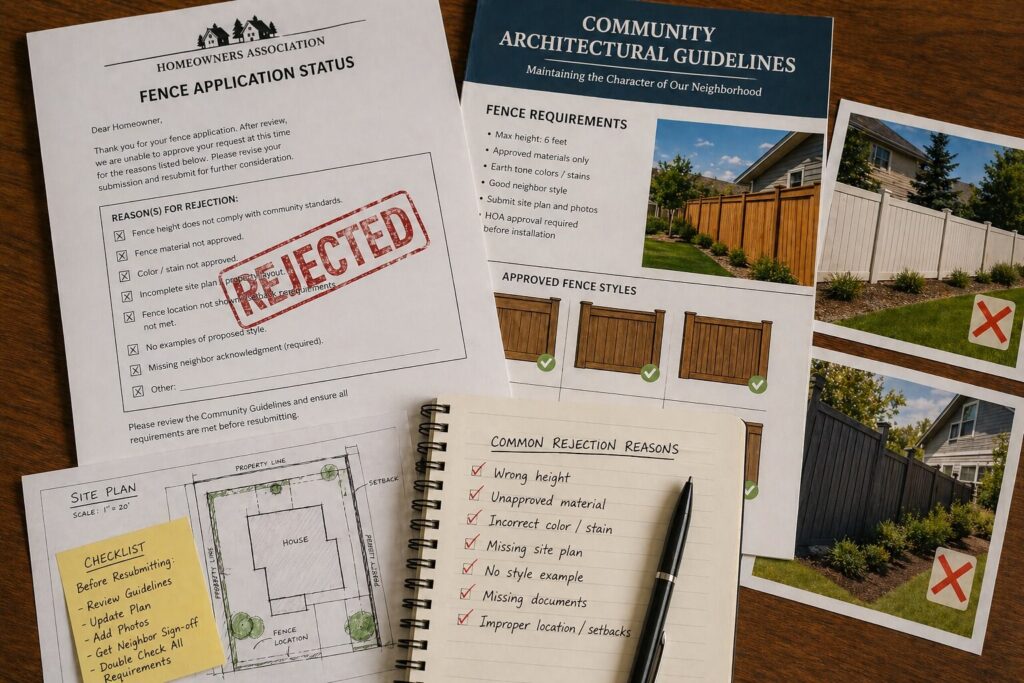
Why HOA Fence Applications Get Rejected (and How to Avoid It)
Common HOA violations include mismatched materials, incorrect heights, and modifications without prior approval.
Material Mismatch
The proposed material doesn’t appear on the approved list, or the manufacturer specified isn’t one the HOA recognizes. The fix: cross-check the approved materials list before the consultation, not after.
Color Drift
“Tan” in one manufacturer’s line looks notably different from “tan” in another. Submitting a generic color name without a manufacturer code invites rejection. The fix: always include the manufacturer’s official color code from the spec sheet.
Height Errors
Most HOAs allow 6-foot rear-yard fencing but restrict front-yard fences to 36 inches (closed-vision) or 48 inches (open-vision). Corner lots add additional restrictions because the side facing the street is treated as a front yard. Eagle additionally prohibits chainlink fencing entirely in residential zoning districts.
Setback Violations
Fences placed on the property line without confirming easement boundaries are a frequent rejection cause. Utility easements, drainage easements, and shared access easements typically prohibit permanent structures, including fences. The recorded plat shows these clearly.
Common-Lot Boundary Issues
Fences along common-lot boundaries (where a lot abuts an HOA-owned greenbelt, pathway, or open space) are subject to additional review. The HOA may require a specific style, may prohibit fencing entirely, or may require open-vision fencing rather than privacy fencing to maintain sightlines along walking paths.
Pre-Construction Without Approval
This is the unforced error. Even a perfect fence, installed before written approval, can trigger a removal order. HOAs in Idaho have legal authority to enforce CC&Rs through liens and court action under Idaho Code Title 55, Chapter 32 (HOA Act).
Notable Treasure Valley Communities and Their Fence Standards
Each major Treasure Valley HOA community has its own variation on the standard rules. The patterns below reflect typical requirements; always verify against current Design Guidelines before submission.
| Community | City | Common Approved Materials | Distinctive Rule |
| Pinnacle | Meridian | Vinyl, ornamental iron, cedar | Modern aesthetic favored; matte black metal posts permitted |
| Paloma Ridge | Meridian | Vinyl (tan/almond), cedar with stain | Common-lot fences require open-vision style |
| Prescott Ridge | Meridian | Vinyl, ornamental iron | Specific manufacturer color codes required |
| DeMeyer Estates | Meridian | Cedar with picture-frame detail | Wood-only along certain perimeters |
| River District | Eagle | Wrought iron, cedar (clear/premium grade) | ACC review through Elitharp Property Management; 35-business-day review |
| Brighton Corporation Communities | Various | Varies by sub-community | Master developer; each community has its own ACC |
Eagle’s zoning rules add a layer beyond HOA requirements. New fencing along streets identified as collectors or arterials, and on the street side of all corner lots, must be open-vision style (such as wrought iron) under Eagle City Code 8-3-3. Chainlink is prohibited in all R (Residential) zoning districts citywide. These city rules apply on top of any HOA Design Guidelines.

How to Work with a Fence Contractor on HOA Documentation
The right contractor handles HOA paperwork as part of the standard process, not as an afterthought. The wrong contractor delivers a great fence that triggers a violation letter.
During the initial consultation, ask the contractor specifically:
- Have you submitted to this HOA before?
- Do you have a documentation packet you can include with my application?
- Will you provide manufacturer spec sheets and color samples?
- Are you on this HOA’s approved vendor list (if applicable)?
- What’s your typical timeline from approval letter to installation?
Butte Fence has submitted documentation to most major Treasure Valley HOAs over 30 years of operation, including communities under Brighton Corporation development, Sentry Management portfolios, and individual ACCs across Meridian, Eagle, Boise, Kuna, and Star. Manufacturer spec sheets, color samples, and site plan templates are part of the standard quote package, which shortens the homeowner’s submission preparation from days to about an hour.
For homeowners managing the application themselves, the most important contractor deliverables are:
- (1) A digital site plan that can be marked up and submitted
- (2) Manufacturer spec sheets in PDF, a physical material sample (or arrangement to pick one up at the showroom)
- (3) Clear documentation of installation methods (post depth, concrete volume, gate hardware) for HOAs that ask.
Realistic Timeline: From Decision to Installation
| Phase | Typical Duration | Notes |
| Contractor Quote & Site Visit | 3–7 days | Faster with established local contractors |
| HOA Application Preparation | 2–5 days | Document gathering, samples, site plan |
| HOA Review | 14–35 business days | Varies by community; some meet monthly |
| City/County Permit | 3–10 business days | Meridian R-FEN: typically 3–5 days |
| Material Lead Time | 2 days (Butte Fence on-site fab) vs. 8–10 weeks (national suppliers) | On-site fabrication is the differentiator |
| Installation | 1–5 days | Depends on linear footage and terrain |
| Total: Decision to Complete | 4–6 weeks (typical) | Can extend to 12–16 weeks if non-local supplier |
The biggest swing in the timeline is material lead time. Homeowners who go with national suppliers facing 8–10 week backlogs often see their HOA approval expire (most approvals are valid for 90–180 days) before the fence can be installed, requiring resubmission. Local fabrication eliminates this risk entirely.
Frequently Asked Questions: HOA Fence Approval in the Treasure Valley
How long does HOA fence approval take in the Treasure Valley?
Most Meridian and Boise HOAs review applications within 14–21 business days. Eagle’s River District Architectural Control Committee operates on a 35-business-day review window. Some HOAs meet monthly, which can extend the timeline if a submission lands just after a meeting. Plan for 3–5 weeks from submission to written approval.
Can I install my fence while waiting for HOA approval?
No. Starting work before written approval is the single most common HOA fence violation. Even fences that fully comply with the rules can be ordered removed if installation begins before approval. Wait for the written approval letter and keep it filed with home records.
What happens if my HOA fence application is rejected?
Most HOAs provide a written rejection notice listing the specific issues. Common fixes include providing a manufacturer color code instead of a generic color name, adjusting setbacks to clear an easement, modifying the height to match HOA limits, or substituting an approved material. Resubmissions typically receive expedited review since the HOA has already seen most of the package.
Do I need a city permit AND HOA approval?
Yes, in most cases. HOA approval is a private requirement enforced through CC&Rs. City or county permits are public requirements enforced through municipal code. Both are typically required, and one does not substitute for the other. Meridian requires a Residential Fence Permit; Boise requires a permit for fences over 7 feet; Eagle requires both Design Review (city) and a building permit for fences over 6 feet.
What if there’s no HOA in my neighborhood?
Older Treasure Valley neighborhoods (parts of Boise’s North End, Boise Bench, and unincorporated Ada County) often have no HOA. In these areas, only the city or county permit applies. The fence must still meet municipal zoning rules for height, setback, and corner-lot visibility, but there’s no separate architectural review.