
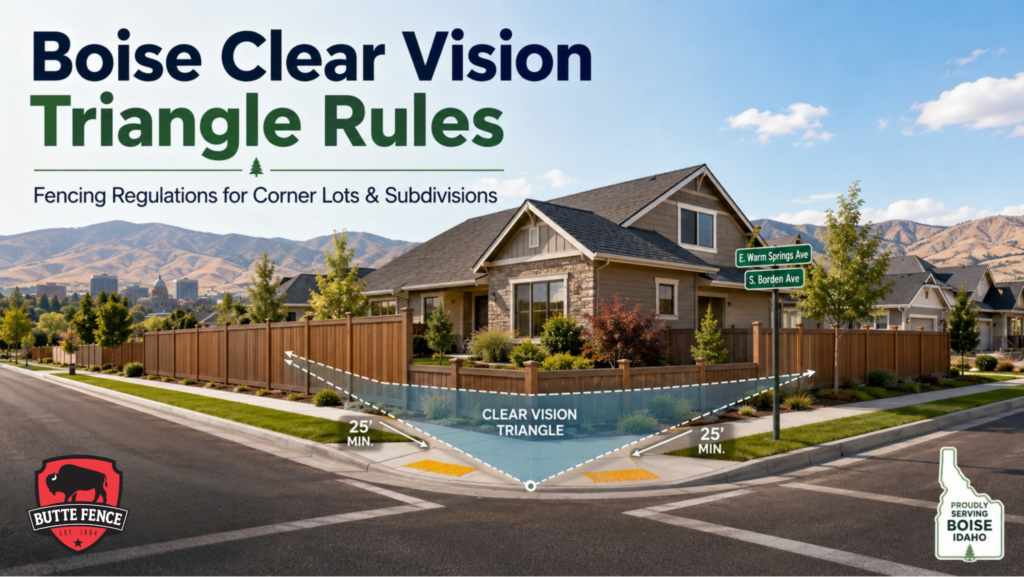
Boise’s Clear Vision Triangle requires unobstructed sightlines at street intersections and driveways. The triangle measures 40 feet along each roadway from the intersection corner; within that area, fences and obstructions are limited to 36 inches in height. Driveway triangles measure 10 feet into the lot and 20 feet along the sidewalk. Butte Fence designs subdivision fencing to clear these requirements before plans go to ACHD review.
Clear Vision Triangle violations are one of the most common reasons fence permits get denied in the City of Boise. They are also one of the easiest violations to avoid—if the rules are understood before the fence layout is drawn. For land developers managing 100+ unit subdivisions and homeowners on corner lots, the dimensional requirements are non-negotiable and enforced jointly by Boise Planning and Development Services and the Ada County Highway District (ACHD).
This guide covers the exact measurements, the differences between street-corner and driveway triangles, the height limits within them, and the practical implications for fence layout in growth-corridor subdivisions near Ten Mile Crossing, Eagle Road, and Chinden Boulevard.
What Is a Clear Vision Triangle in Boise?
A Clear Vision Triangle is a defined area at street intersections and driveway entrances where visual obstructions must be limited to preserve sightlines for drivers, cyclists, and pedestrians. The concept exists in nearly every municipality, but Boise’s specific dimensions and height rules are governed by Boise City Code Title 11 and enforced through both the city’s zoning review and ACHD’s public right-of-way standards.
Boise’s Clear Vision Triangle measures 40 feet along each roadway from the intersection corner.
That 40-foot measurement is taken from the intersection of the edges of two adjacent streets, with each leg extending 40 feet along the respective roadway. A straight line connecting those two endpoints forms the hypotenuse of the triangle. Inside that triangular area, height-restricted standards apply.
The triangle’s purpose is engineering, not aesthetic. Drivers approaching an intersection need a sightline window that allows them to see cross-traffic, pedestrians stepping off curbs, and cyclists in adjacent travel lanes. A 6-foot privacy fence positioned three feet from the curb at a corner lot eliminates that window entirely—which is why Boise prohibits it.
Street Intersections vs. Driveways: Two Different Triangles
Boise applies Clear Vision Triangle rules in two distinct scenarios with different measurement methods.
| Element | Street Intersection | Driveway |
|---|---|---|
| Measurement Origin | Intersection of the edges of two adjacent streets | Sidewalk edge closest to the lot (or property line if no sidewalk) |
| Leg 1 Length | 40 feet along one roadway | 10 feet into the lot, perpendicular to the street |
| Leg 2 Length | 40 feet along the other roadway | 20 feet along the sidewalk parallel to the street |
| Vertical Restriction Band | 3 feet to 10 feet above grade | 3 feet to 10 feet above grade |
| Maximum Obstruction Height | 36 inches | 36 inches |
| Common Application | All corner lots and street/railroad intersections | Every driveway entry, including subdivision common drives |
Within Boise’s Clear Vision Triangle, fences, walls, and plantings are limited to 36 inches in height.
The 36-inch limit applies regardless of fence material. Wood, vinyl, ornamental iron, and chain link are all subject to the same restriction inside the triangle. The height is measured from the crown of the street—the highest point of the road surface—not from the ground level inside the lot. On lots that sit lower than the adjacent street, this is a critical distinction that catches many homeowners and contractors off guard.
The 3-to-10-Foot Vertical Band: What It Means in Practice
Boise’s rules define a vertical band of 3 to 10 feet above grade within the Clear Vision Triangle. Below 3 feet, low landscaping, mailboxes, and short fences are typically permitted. Above 10 feet, mature tree canopies are allowed (deciduous trees must be pruned to a minimum of 8 feet above the sidewalk and 14 feet above the roadway). The protected sightline window—where nothing taller than 36 inches is permitted—falls within that 3-to-10-foot vertical band.
In practice, this means a developer planning corner-lot fencing in a new subdivision near Ten Mile Crossing or Eagle Road has the following options inside the triangle:
• A 36-inch picket fence (closed-vision allowed up to that height)
• A 48-inch open-vision fence such as ornamental iron with widely spaced pickets, IF the open-vision design provides genuine see-through visibility (some interpretations of “open-vision” still require the 36-inch limit at corners depending on ACHD review)
• Landscaping under 36 inches in height
• No fence at all in the triangle, with the standard fence beginning at the triangle’s edge
Most developer-grade subdivision plans choose option four—terminating the privacy fence at the triangle boundary and either leaving the corner open or transitioning to landscaping or a 36-inch decorative element. This avoids ambiguity at inspection.
Boise Front Yard and Corner Lot Fence Heights
Beyond the Clear Vision Triangle itself, Boise zoning code limits front yard fence heights generally—with rules that apply across the front of the property regardless of corner-lot status.
| Location on Lot | Solid / Closed-Vision Fence | Open-Vision Fence |
|---|---|---|
| Front yard / front property line | 36 inches max | 48 inches max |
| Side property line, in front yard setback | 36 inches max | 48 inches max |
| Side property line, behind front yard setback | 72 inches (6 ft) max | 72 inches (6 ft) max |
| Rear property line | 72 inches (6 ft) max | 72 inches (6 ft) max |
| Within Clear Vision Triangle | 36 inches max | 36 inches max |
| Ornamental gate/entryway in front setback | Up to 8 ft tall × 6 ft wide (one allowed; not in CVT) | Same |
For corner lots, the side facing the street is treated as a front yard for fence-height purposes. This is a common point of confusion: a homeowner in Boise’s East End or near the Boise Bench may have a 6-foot privacy fence along the back property line but be limited to 48 inches along the side that fronts the cross-street. Both sides face the public realm, so both are subject to front-yard restrictions.
Fences over 7 feet tall, and concrete or masonry walls of any height in mixed-use districts, require additional approval from the Boise Building Department under Section 11-04-09 of the city code.
ACHD Coordination: Why Public Right-of-Way Matters
The Ada County Highway District owns and maintains all public roadways, sidewalks, and adjacent right-of-way in Boise, Meridian, Eagle, Star, and Kuna. ACHD coordinates with the City of Boise on Clear Vision Triangle enforcement—and any fence proposed within the public right-of-way requires ACHD approval in addition to city zoning approval.
Fences in Boise’s public right-of-way require Ada County Highway District approval in addition to city zoning approval.
This is particularly relevant for developer projects where the boundary between private lot and ACHD right-of-way isn’t obvious from a casual review. Sidewalk easements, drainage swales, and curb-adjacent landscape strips are often ACHD-controlled even when they appear to be on private lots. A fence proposed in these areas needs ACHD signoff before construction.
For a 120-unit subdivision near Ten Mile Crossing, for example, common-lot fencing along arterial frontage may require negotiation between the developer, the city, and ACHD over fence type, setback from the curb, and any easements granted for sight-distance maintenance. These conversations happen during platting, not after.

What Clear Vision Triangle Rules Mean for Subdivision Developers
For Senior Land Development Managers and Site Engineers planning new subdivisions in Boise’s growth corridors, Clear Vision Triangle rules drive several practical decisions in the platting phase.
Corner Lot Configuration
Every corner lot in the subdivision will face Clear Vision Triangle restrictions. Lot layouts that minimize the percentage of corner lots—or that orient corner lots so the buildable area falls outside the triangle—reduce the marketability impact. Buyers paying premium prices for corner lots want full perimeter privacy, and the Clear Vision Triangle limits what the eventual homeowner can install. Disclosing this clearly in the lot purchase documentation prevents complaints down the line.
Common-Lot Fence Design
Subdivision common-lot fences (often the perimeter fence along arterials like State Street, Chinden Boulevard, or Eagle Road) must terminate at every Clear Vision Triangle boundary. A continuous 6-foot privacy fence along an arterial is not permitted where intersections occur. Plans typically show fence breaks at every cross-street, with the fence either ending or transitioning to a 36-inch decorative segment within the triangle.
Pedestrian Pathway Crossings
Where micro-paths or pedestrian connections cross the perimeter fence, additional Clear Vision Triangle considerations apply. The pathway crossing acts similar to a driveway in terms of sightline requirements—pedestrians emerging from the path need to see oncoming vehicles, and drivers need to see pedestrians.
ACHD-Required Easements
On platted subdivisions, ACHD often requires recorded sight-distance easements at corner lots that prohibit any future obstruction taller than 36 inches. These easements run with the land and bind future homeowners. Including them in the plat eliminates ambiguity later.
ACHD requires sight-distance easements at corner lots in platted Boise subdivisions to enforce Clear Vision Triangle rules permanently.
Butte Fence works with developers across the Treasure Valley—including Brighton Corporation projects, Toll Brothers communities, and individual subdivision builds—to design common-lot fence plans that clear Clear Vision Triangle review before submission. With on-site fabrication and 2-day lead times, fence construction can begin immediately upon final approval rather than waiting 8–10 weeks for material delivery.
Pre-Submission Compliance Checklist
Before submitting a fence permit application to Boise Planning and Development Services—whether for a single corner lot or a multi-unit subdivision—the following review items prevent the most common rejections.
□ Clear Vision Triangle correctly drawn on site plan, with both legs measured from the correct origin point (intersection edge for street triangles, sidewalk edge for driveway triangles)
□ All proposed fence heights inside the triangle are 36 inches or less
□ Front yard fence heights match Boise’s 36-inch closed / 48-inch open vision limits
□ Corner lot side-street fencing treated as front yard, not side yard
□ Setbacks from sidewalks and easements verified against the recorded plat
□ ACHD approval obtained for any fence within or adjacent to public right-of-way
□ Building Department approval obtained for fences over 7 feet or any masonry wall
□ Ornamental gate/entryway, if proposed, is outside the Clear Vision Triangle and within the 8-foot height × 6-foot width cap
□ Heights measured from the crown of the street, not from the lot’s lowest interior grade
□ Materials and colors comply with any applicable HOA Design Guidelines as well as city code
Frequently Asked Questions: Boise Clear Vision Triangle and Corner Lot Fences
How is the Clear Vision Triangle measured at a Boise street corner?
At a street intersection, the triangle is formed by measuring 40 feet along the edge of one roadway from the intersection corner, then 40 feet along the edge of the perpendicular roadway, and connecting those two points with a straight line. The resulting triangular area is subject to the 36-inch height restriction for fences, walls, and plantings between 3 and 10 feet above grade.
Does the Clear Vision Triangle apply to driveway entrances too?
Yes. At driveway entrances, Boise measures a smaller triangle: 10 feet into the lot from the sidewalk edge (or property line if no sidewalk), and 20 feet along the sidewalk parallel to the street. The same 36-inch height limit and 3-to-10-foot vertical band apply. This catches a lot of homeowners who place 6-foot privacy fences right up to the driveway opening.
Can I install a 6-foot fence on my Boise corner lot?
Yes, but with restrictions. A 6-foot fence is allowed along the rear property line and along the side property line behind the front yard setback. Along the side property line that fronts the cross-street, the fence is treated as a front-yard fence and limited to 36 inches solid (or 48 inches open-vision). Inside any Clear Vision Triangle, the limit drops to 36 inches regardless of material.
What happens if my fence violates the Clear Vision Triangle?
Boise Planning and Development Services issues a violation notice requiring removal or modification of the non-compliant portion. Failure to comply can result in fines, a lien on the property, or court enforcement. ACHD can also act independently if the violation affects public right-of-way. The cost of correcting a violation after installation typically exceeds what a compliant design would have cost up front.
Are there any exceptions to the 36-inch height limit in the triangle?
Limited exceptions exist. Deciduous trees pruned to a minimum of 8 feet above the sidewalk and 14 feet above the roadway are permitted. One ornamental gate or entryway is allowed in the front or street-side setback up to 8 feet tall and 6 feet wide, but only if it is located outside the Clear Vision Triangle. Variances from the height limit can be requested through the variance process under Section 11-06-11 of the city code, but they are rarely granted for sight-distance restrictions.