
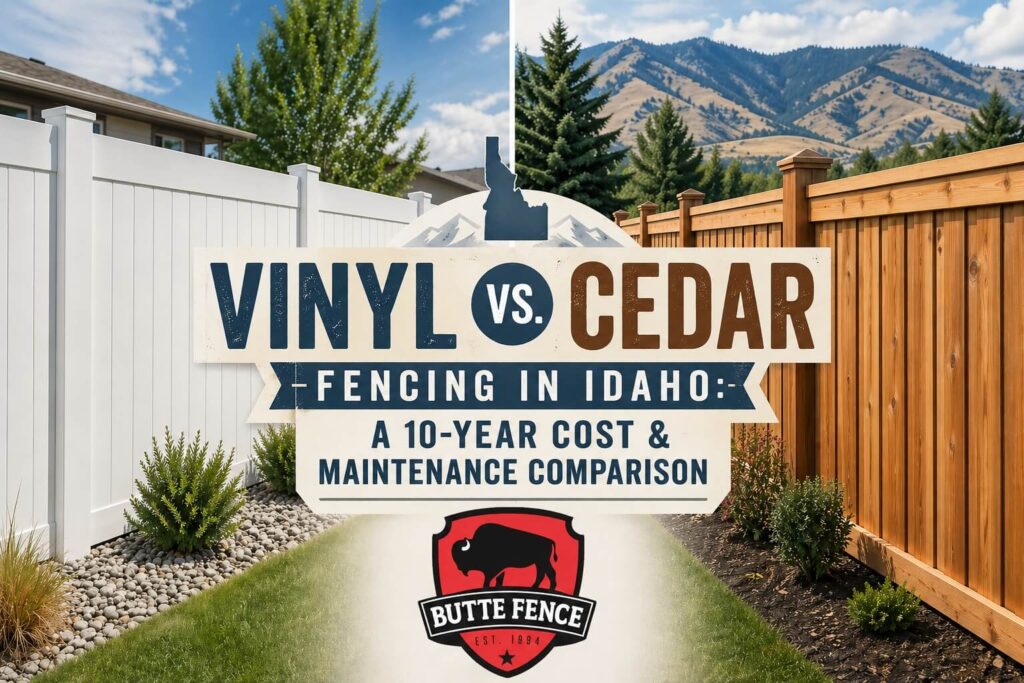
Over 10 years in Idaho, vinyl fencing costs less than cedar when factoring maintenance. Cedar requires staining every 2-3 years ($500-$800 per cycle) and averages 15-year replacement. Vinyl needs only water rinsing and carries lifetime warranties. Butte Fence provides both with honest guidance based on the specific property and budget.
Most Idaho homeowners pricing a new fence look at one number: cost per linear foot installed. Cedar wins that comparison. But that comparison is also incomplete. The true cost of a fence isn’t what gets paid on installation day—it’s what the fence costs to own across its lifespan, including the staining cycles, the board replacements, the gate repairs, and eventually the full teardown.
This article walks through the full 10-year math for vinyl and cedar fencing in the Treasure Valley and Magic Valley climate, drawing on local pricing from Boise, Meridian, Twin Falls, and Kimberly. The goal is a clear-eyed answer to the question every replacement-cycle homeowner asks: which one actually costs less?
Cedar vs. Vinyl: What Does Each Cost Upfront in Idaho?
Local Idaho pricing for installed 6-foot privacy fencing in 2026 generally falls within these ranges, depending on terrain, gate count, and material grade.
| Material | Cost / Linear Foot (Installed) | 150 LF Yard | Typical Lifespan |
| Cedar (standard grade) | $22–$32 | $3,300–$4,800 | 10–15 years |
| Cedar (premium with metal posts) | $30–$45 | $4,500–$6,750 | 15–20 years |
| Vinyl (standard grade) | $28–$40 | $4,200–$6,000 | 30+ years |
| Professional-grade vinyl (steel-reinforced) | $38–$55 | $5,700–$8,250 | 30+ years (lifetime warranty) |
| Big-box vinyl (DIY kit) | $15–$25 materials only | $2,250–$3,750 + labor | 10–20 years |
On installation day, cedar typically wins by $1,000 to $3,000 on a standard 150-foot residential perimeter. That gap is real—but it closes faster than most homeowners expect once the maintenance clock starts.
The phrase “professional-grade vinyl” matters here. The vinyl panels stocked at big-box stores are not the same product Butte Fence installs. Big-box vinyl is typically thinner-walled, lacks UV inhibitors rated for high-altitude sun, and uses hollow plastic posts instead of steel-reinforced posts. The performance gap shows up within 5–10 years—faded color, brittle panels, leaning posts. Comparing big-box vinyl to professional-grade vinyl is comparing two different products that share a name.

Cedar Maintenance Costs in Idaho: The Hidden Bill
Cedar fencing in Idaho doesn’t fail because cedar is bad wood. It can fail because the climate is unusually hard on it… but that’s primarily because the wood is cheap or low quality. Treasure Valley and Magic Valley summers deliver intense UV exposure that can break down cedar’s natural oils, so it’s important – when opting for wood fence installation – that you choose high-quality cedar. Winter freeze-thaw cycles work moisture into the grain, splitting boards and warping rails. Sprinkler overspray is the silent killer—the soil-to-wood interface stays wet for years, accelerating rot from the bottom up.
Cedar fences in Idaho require staining or sealing every 2-3 years, adding $500-$800 per maintenance cycle.
That staining cycle is not optional if the fence is going to reach its full lifespan. Skipping a cycle in Idaho’s climate is the difference between a 15-year cedar fence and an 8-year cedar fence. The cost per cycle for a 150-foot fence breaks down to roughly $300–$500 in materials (stain, brushes, sprayer rental, prep supplies) plus labor—either the homeowner’s weekend or a professional staining crew at $1.50–$3.00 per linear foot.
Beyond staining, cedar requires periodic spot repairs. Individual pickets warp, split, or rot at the soil line. Gates sag and need rehanging. Posts loosen as the wood-soil interface degrades. A realistic budget across 10 years includes 3–4 staining cycles plus ongoing minor repairs averaging $100–$200 per year.
The soil-to-wood interface is the primary failure point for cedar fences in irrigation-heavy Idaho landscapes.
This is why properties with extensive sprinkler systems—common across Meridian, Eagle, Nampa, and the Boise Bench—see cedar deteriorate faster than properties with drip irrigation or xeriscaped beds. The same fence that lasts 20 years in a dry-yard installation may need replacement at 10–12 years if it’s sprayed daily by a lawn rotor.
Annual Maintenance Requirements: Side by Side
| Maintenance Task | Cedar | Professional-Grade Vinyl |
| Staining / Sealing | Every 2-3 years; $500-$800 per cycle | Never required |
| Cleaning | Pressure wash before staining | Garden hose rinse 1-2x per year |
| Picket Replacement | 5-15% of pickets over 10 years | Rare; covered by warranty |
| Post Replacement | 1-3 posts likely over 10 years | Steel-reinforced posts: rare |
| Gate Hardware | Hinges loosen as wood softens | Stable; mounted into reinforced posts |
| UV Damage | Graying, splitting, surface cracking | Color stable with UV inhibitors |
| Pest Damage | Termite and carpenter ant risk | Inert; no pest food source |
| Annual Cost Estimate | $200-$350 (averaged across cycles) | $0-$25 |
Quality vinyl fencing is resistant to rot, termites, UV damage, and moisture—eliminating recurring maintenance costs.
The annual cost gap is where the real story lives. A cedar fence quietly extracts $200–$350 per year in maintenance. A professional-grade vinyl fence extracts almost nothing. Spread across 10 years, that difference is $2,000–$3,500—enough to fully close the upfront cost gap and then some.
10-Year Total Cost of Ownership: The Real Number
Here’s how the math plays out for a typical 150-linear-foot residential perimeter in Boise, Meridian, or Twin Falls, using midpoint pricing.
| Cost Category | Cedar (150 LF) | Professional Vinyl (150 LF) |
| Initial Installation | $4,000 | $6,500 |
| Year 2-3: First Stain Cycle | $650 | $0 |
| Year 4-6: Second Stain Cycle | $650 | $0 |
| Year 7-9: Third Stain Cycle | $650 | $0 |
| Year 10: Fourth Stain Cycle | $650 | $0 |
| Spot Repairs (10 yrs) | $1,000–$1,500 | $0–$200 |
| Cleaning Supplies (10 yrs) | $200 | $50 |
| 10-Year Total (Approximate) | $7,800–$8,300 | $6,550–$6,750 |
| Cost Per Year | $780–$830 | $655–$675 |
By year 10, vinyl is roughly $1,250–$1,500 cheaper than cedar on a 150-foot installation. That gap widens significantly in years 11–20, because cedar will likely need full replacement somewhere in that window while vinyl continues operating under its lifetime warranty.
A typical cedar fence in Idaho’s climate lasts 10-15 years; professional-grade vinyl carries lifetime limited warranties.
The 20-year picture is even starker. Cedar at year 15–20 typically needs full teardown and replacement—another $4,000–$5,000 (in today’s dollars, more with inflation). Vinyl at year 20 is still under warranty and looks essentially the same as the day it was installed. The 20-year cost comparison is not close.

How Each Material Performs in Idaho’s Climate
UV Exposure
Idaho sits at high elevation with low humidity—a combination that delivers intensified UV exposure. Cedar responds by graying, drying, and developing surface cracks within 2–3 years if unsealed. Stain extends UV resistance, but the protective film breaks down on roughly the same 2–3 year cycle. Professional-grade vinyl includes titanium dioxide UV inhibitors compounded into the polymer, not just applied as a surface coating. The result: color stability across decades. Big-box vinyl typically uses lower UV-inhibitor concentrations and yellows or chalks within 5–10 years.
Freeze-Thaw Cycles
The Treasure Valley sees 80–100 freeze-thaw cycles per year. For cedar, this means moisture absorbed during freezing weather expands inside the wood grain, splitting boards and lifting nails. Stain helps but doesn’t eliminate the issue. Vinyl is dimensionally stable across the temperature range—it doesn’t absorb moisture, so freeze-thaw has no degradation effect on the panels themselves. Post settling can still occur with both materials if installation depth is below the 24-inch frost line, which is why proper post installation matters more than picket material.
Wind Exposure
Magic Valley wind events regularly exceed 70 mph, with occasional gusts above 100 mph. Cedar privacy fencing presents a solid wind sail—the same wind load that breaks pickets in Twin Falls and Kimberly. Wood loosens at fasteners, and entire panels can blow out. Professional-grade vinyl with steel-reinforced posts and interlocking tongue-and-groove panels distributes wind load across the full fence length rather than concentrating it on individual pickets. This is why wind-rated vinyl carries warranties in the 100–130 mph range that cedar simply cannot match.
Sprinkler Exposure
Almost every Treasure Valley yard has automated irrigation. The bottom 6–12 inches of every cedar fence panel gets sprayed multiple times per week from May through October. Cedar absorbs that moisture and rots from the bottom up. Vinyl is unaffected—moisture doesn’t penetrate the polymer. For homeowners with pop-up rotors near fence lines, vinyl is essentially the only material that doesn’t face a slow soaking death.
When Cedar Still Makes Sense
Cedar isn’t the wrong answer for every property – we want to make that clear. There are specific scenarios where the math tips back in cedar’s favor.
Short-Term Ownership
If the property will be sold in 3–5 years, the upfront cost savings on cedar may not be offset by maintenance because few staining cycles will hit during the ownership window. The 10-year math doesn’t apply.
Aesthetic Priority
Cedar has a natural grain and warmth that vinyl can’t fully replicate. For homeowners who want the look of natural wood and accept the maintenance commitment, cedar is a legitimate choice—especially in historic neighborhoods of the Boise Bench or North End where the character of the home calls for natural materials.
Budget Constraints
If the upfront difference between cedar and vinyl is the difference between installing a fence now versus waiting two years to save more, cedar today often beats vinyl never. A maintained cedar fence is better than no fence.
HOA Restrictions
Some Treasure Valley HOAs restrict materials to wood for aesthetic continuity. Communities like certain sections of the Boise Foothills or older established neighborhoods may require cedar. This is increasingly rare in newer subdivisions like Pinnacle, Paloma Ridge, and Prescott Ridge, where vinyl is broadly accepted.
Specific Use Cases
For tall privacy fencing (8 feet or higher), or for specialty designs like horizontal-slat modern fences, cedar offers more design flexibility than standard vinyl panel sizes. Custom fabrication closes some of this gap on the vinyl side, but cedar remains the easier custom material.
Questions to Ask Any Idaho Fence Contractor
Whether the choice is cedar or vinyl, the installer matters as much as the material. The right questions before signing a contract surface the difference between a fence that lasts and a fence that fails early.
For cedar quotes: What grade of cedar is being used (clear, select, knotty)? Are posts cedar, pressure-treated pine, or steel? How deep are post holes (must be below the 24-inch frost line)? What stain or sealer is recommended for the first cycle, and is it included? What’s the warranty against warping or splitting?
For vinyl quotes: Is the vinyl professional-grade (.135 inch wall thickness or greater) or big-box (often .090 inch)? Are posts steel-reinforced or hollow vinyl? What is the UV-inhibitor specification? What does the manufacturer warranty cover, and for how long? Are panels tongue-and-groove or face-nailed?
For both: Who handles permits and HOA documentation? What’s the timeline from contract to completion? Is the labor in-house or subcontracted? Is there a warranty on installation workmanship separate from the manufacturer warranty?
Butte Fence stocks both professional-grade vinyl and cedar across the largest fencing inventory in Idaho, with on-site fabrication enabling 2-day lead times for custom configurations. The honest recommendation depends on the property, the timeline, and the budget—not on what the salesperson is trying to push that month.
Frequently Asked Questions: Vinyl vs. Cedar in Idaho
Is vinyl fencing worth the higher upfront cost in Idaho?
For homeowners staying in their property for 7 years or more, yes. The maintenance savings on vinyl typically offset the upfront premium between years 6 and 8 in Idaho’s climate. By year 10, vinyl is the cheaper option. By year 20, the cost gap is significant. For shorter ownership windows, cedar may make more financial sense despite its maintenance requirements.
How long does a cedar fence really last in Boise or Meridian?
With consistent staining every 2–3 years and proper post installation below the 24-inch frost line, cedar fences in the Treasure Valley typically last 10–15 years. Without consistent maintenance, that drops to 7–10 years. Premium cedar installations using metal posts and proper grade clearance can reach 20 years.
Does vinyl fencing fade or yellow in Idaho’s sun?
Professional-grade vinyl with titanium dioxide UV inhibitors compounded into the polymer maintains color stability for 20+ years in Idaho’s high-altitude sun. Big-box vinyl with surface-only UV protection often yellows or chalks within 5–10 years. The specification difference is the most important question to ask any vinyl installer.
Can cedar and vinyl be mixed on the same property?
Yes. Many Treasure Valley homeowners install vinyl along sprinkler-heavy property lines where cedar would rot quickly and use cedar in dry, decorative areas. This hybrid approach captures the aesthetic appeal of cedar in visible spaces while protecting the bulk of the perimeter with low-maintenance vinyl. Butte Fence regularly designs mixed-material installations.
What’s the warranty difference between cedar and professional vinyl?
Cedar fencing typically carries 1–5 year warranties against manufacturing defects, with warping, splitting, and weathering generally excluded. Professional-grade vinyl carries lifetime limited warranties from major manufacturers, often transferable to the next homeowner. The warranty difference reflects the underlying durability difference—and is part of why vinyl can be priced as a one-time purchase rather than a recurring expense.